Four-bin system
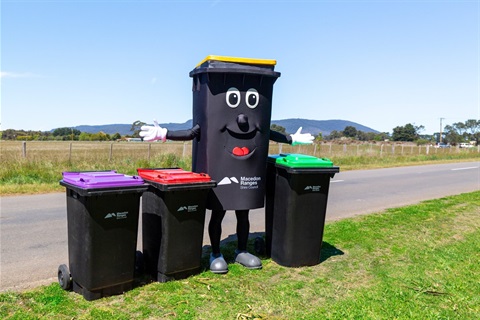
The four-bin collection service started on 3 February 2020 in major townships and was rolled out in remaining areas of the shire in July 2021.
The four-bin system consists of:
This service aligns with the objectives and goals of the Waste and Resource Recovery Management Strategy 2021-2026. The central focus of the strategy is the diversion of waste from landfill.
The Kerbside Collection and Associated Services Charge Policy outlines how the four-bin service works.
Why the four-bin system?
Under the Victorian Government’s Circular Economy Policy released in February 2020, all Victorian councils must have a standard four-bin system or equivalent by 2030 to achieve more and better recycling and less landfill.
Additionally, Victoria is running out of landfill space, which can increase the cost to dispose of waste, which attracts a fee known as the ‘EPA Waste levy’. This cost is passed directly onto ratepayers through the waste charge on your rates notice. By introducing the four-bin system, we can minimise future cost increases by diverting materials away from landfill.
Achievements so far
We are one of the first councils in Victoria to have introduced a four-bin system, and in February 2026 we celebrated six years of the new service.
- 61,777 tonnes of FOGO material was sent to local processors and is being turned into Australian standard compost.
- 17,464 tonnes of recycling was sent to APR in Truganina for processing of paper/cardboard, steel, aluminium and hard plastic.
- 10,191 tonnes of glass was sent to ASQ in Bendigo and is being repurposed into road base materials.
This means the Shire has diverted over 89,433 tonnes of waste from landfill!
Monthly landfill diversion rate has increased from 39 percent in January 2020 (pre-introduction) to 72 percent, which is much higher than the average Victorian municipal diversion rate of 45 percent recorded for 2019/20.
Together we can continue to reduce waste to keep our Shire beautiful and sustainable.
2025 Kerbside waste audit results
A recent shire-wide audit of kerbside bins has confirmed what we already know - Macedon Ranges residents care about doing the right thing with their waste. The audit showed we’re nailing it when it comes to separating glass into the purple-lidded bins and performing strongly with our green and yellow-lidded bins. But there’s still room to improve what goes into our red-lidded general waste bins.
The independent audit examined 250 bins from each of the four waste streams: glass, Food Organics Garden Organics (FOGO), recycling, and general waste. In total, more than 3,200kg (23,000L) of material was sorted and analysed for contamination (items placed in the wrong bin).
Red-lidded general waste bins
- Households produced an average of 6.4kg (59L) of general waste each week.
- Recyclable and FOGO items were the main contaminants, meaning some materials could have been diverted from landfill.
- Recyclables made up 7% by weight (18.4% by volume)
- Compostable items made up 6.1% by weight (2.4% by volume)
- Hazardous and non-acceptable items, such as batteries, dropped to 1.8% by weight, down from 2.3% in 2024 – a great improvement!
Battery and vape disposal: a continuing safety concern
During the audit, 129 batteries and 11 vapes were found in kerbside bins. Extrapolated across the Shire, this equates to an estimated 260,000 batteries and vapes being disposed of in household bins every year! These items pose a serious fire hazard when placed in kerbside bins, as they can ignite during collection and processing. This not only endangers waste facility staff and collection trucks but can also cause costly and dangerous fires at waste facilities.
Residents are reminded never to place batteries or vapes in any kerbside bin. Instead, they can be safely disposed of at our Resource Recovery Facilities and customer service centres in Gisborne, Kyneton and Romsey for free. Learn more about E-waste.
Yellow-lidded recycling bins
- Households produced an average of 3.2kg (76L) of recycling per week.
- Participation in the Soft Plastics Recycling Program increased fourfold since 2024 - a fantastic result.
Green-lidded FOGO bins
- Contamination was low at 3% by weight (4% by volume), with non-compostable packaging found to be the main issue.
Purple-lidded glass bins
- Households produced around 3.6kg (7.6L) of glass each week, with a low contamination rate of just 2.9% - another strong performance.
Continuing our efforts
Reducing what goes to landfill is a key focus of Council’s Waste and Resource Recovery Management Strategy 2021–2026. The audit gives us more than data - it gives us direction. It helps us celebrate what our community is doing well and shows where we can make simple changes that lead to big results. The findings also guide Council’s waste education strategies, helping us focus on areas where awareness and support can make the biggest difference.
Recycling Reset: Helping You Recycle Right
Council is launching a new ‘Recycling Reset’ campaign, using these audit insights to focus on the most common contamination issues - including polystyrene, batteries, e-waste and textiles.
To further assist our community, there are a series of fun, informative videos that follow the journey of your waste once it leaves the kerb. Visit the FOGO, Recycling, Glass-only and General Waste information pages to watch the videos and learn what belongs (and what does not belong) in each bin.
|
|
|
|
|
|
|
125 properties per stream (375 bins total); ~4 tonnes (50,000L) audited.
|
250 properties per stream (1,000 bins total); 3,206 kg (23,269L) audited.
|
2025 doubled sample size, providing stronger data reliability.
|
|
|
82.8% by weight / 68.5% by volume acceptable. 7% recyclables, 6.8% organics, 2.2% hazardous.
|
84.5% by weight / 77.5% by volume acceptable. 7% recyclables, 6.1% organics, 1.8% hazardous.
|
Improved sorting; reduction in recoverable materials and hazardous items.
|
|
|
75% by weight / 86% by volume acceptable. 21.9% landfill contamination.
|
75% by weight / 85% by volume acceptable. 21% landfill contamination.
|
Stable performance. Slight increase in glass presence.
|
|
|
97.5% by weight / 96% by volume acceptable. Minor landfill and recyclables present.
|
95.5% by weight / 97% by volume acceptable.
|
Slight increase in contamination due to packaged/non-compostable food waste.
|
|
|
|
98.3% by weight / 97% by volume acceptable. 2.1% contamination.
|
First time audited - strong performance with low contamination.
|
Soft Plastics (Orange Bags)
|
Pilot phase (Romsey only). 1.25kg collected across 125 bins (10g/hh/week). 0.16% of recycling stream. No contamination.
|
Full rollout. 10.6kg collected across 250 bins (20g/hh/week). 0.7% of recycling stream. 2.3% contamination.
|
Participation greatly increased; strong uptake across the Shire.
|
|
|
0.08% (landfill) and 0.01% (recycling).
|
0.1% (landfill) and 0.09% (recycling). 129 batteries and 11 vapes found - ≈260,000 items annually.
|
Improper disposal increased; significant fire safety concern.
|